

Factors Affecting Heat Transfer of Ceramic Fiber Modules
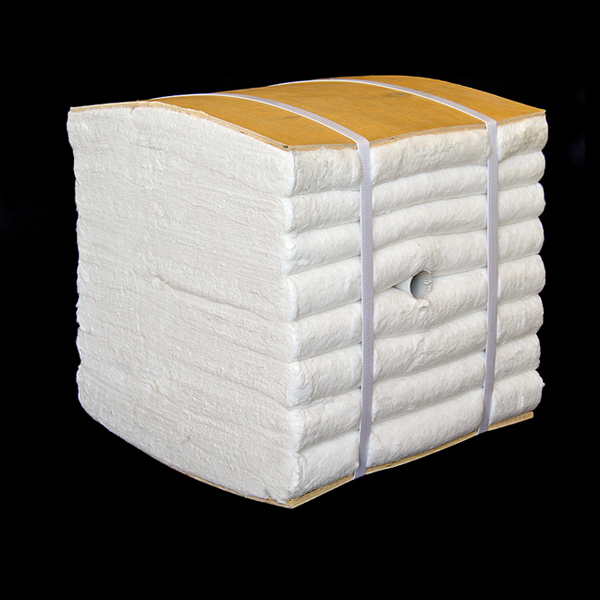
Ceramic fiber modules are widely used in various kilns and industrial furnaces for thermal insulation. Their insulation performance primarily depends on their heat transfer characteristics. In nature, gases (except hydrogen) have the lowest thermal conductivity, and ceramic fiber’s thermal conductivity is close to that of gases. This is because ceramic fibers are composed of interwoven solid fibers with internal gas-filled pores, achieving a porosity of up to 90%. The heat transfer of ceramic fiber modules is influenced by several key factors:
1. Porosity
Thermal insulation materials have an optimal porosity (or bulk density) at different service temperatures, within which insulation performance is maximized. Therefore, ceramic fiber modules are classified into different grades based on usage temperature, with corresponding densities typically ranging from 210 to 260 kg/m³.
2. Environmental Conditions
The low thermal conductivity of ceramic fiber modules assumes the presence of common gases. In environments with high-thermal-conductivity gases such as hydrogen or helium, ceramic fiber products are not suitable.
3. Bulk Density
To maintain low thermal conductivity, the optimal density of ceramic fiber products is generally below 250 kg/m³, with porosity above 90%.
4. Fiber Orientation
Ceramic fiber blankets or boards have a primary orientation determined during manufacturing (length × width). The thermal conductivity along the surface facing high temperature is lower than that along the side. Therefore, during installation, the fiber product should be placed with the backside against the furnace wall and the front surface exposed to high temperature; it should not be installed perpendicular to the wall.


