










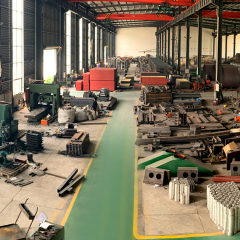


1. Project Background
Under the “Dual Carbon” strategy, the demand for high-performance insulation materials in building energy efficiency, industrial insulation, and transportation sectors is rapidly growing.
Rock wool, produced from natural minerals, is a non-combustible material with excellent fire resistance, thermal insulation, and sound absorption properties, making it highly attractive in global markets.
To meet large-scale continuous production needs, SUNTHERM Group launched the 30,000 TPA Electric Furnace Rock Wool Production Line. By replacing traditional coal/oil melting furnaces with an advanced electric heating process, this line provides customers with a green, low-carbon, and intelligent production solution.
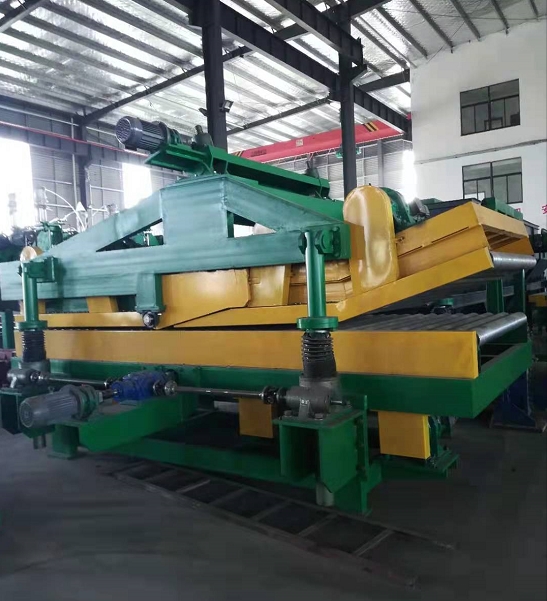
2. Equipment Composition
The production line consists of the following key modules, all of which can be customized:
Ø Raw Material Processing System – automatic crushing, screening, batching, and conveying
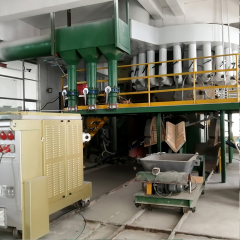
Ø Electric Furnace Melting System – electric arc furnace or resistance furnace, precise temperature control, low emissions
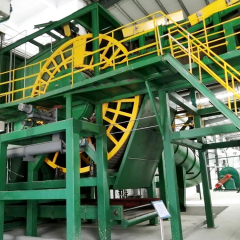
Ø Centrifugal Fiberization System – multi-wheel high-speed spinning for fine and uniform fibers
Ø Spraying & Dust Control System – simultaneous spraying of binder and anti-dust oil, eco-friendly and efficient
Ø Fiber Laying & Forming System – multi-stage pendulum, automatic thickness and uniformity control
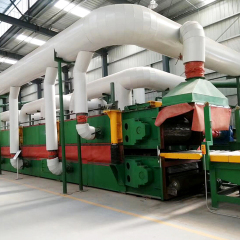
Ø Curing Oven System – hot-air circulation, intelligent temperature control to ensure product strength and stability
Ø Cooling & Conveying System – air cooling + shaping conveyor, protecting product structure
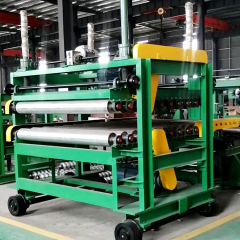
Ø Cutting System – supports transverse, longitudinal, and edge trimming cuts
Ø Packaging & Palletizing System – fully automatic PE film wrapping, heat shrinking, robotic palletizing
Ø Dust & Emission Control System – bag filters + flue gas condensation tower, compliant with emission standards
Ø Central Control System – PLC + touchscreen, compatible with SCADA/MES integration
3. Technical Parameters
|
Item |
Parameter Range |
|
Annual Capacity |
30,000 tons |
|
Raw Materials |
Basalt, dolomite, partial slag |
|
Melting Temperature |
1450–1500℃ |
|
Fiber Diameter |
3–7 μm |
|
Product Density |
40–180 kg/m³ |
|
Product Thickness |
30–200 mm |
|
Automation Level |
Full PLC intelligent control |
|
Plant Area |
15,000–20,000 m² |
|
Energy Consumption |
Electricity-driven, eco-friendly |
|
Operators Required |
6–10 per shift |
|
Environmental Features |
Dust removal + desulfurization + VOC control |
4. Core Advantages
(1)Green Melting, Energy Saving & Emission Reduction
Electric furnace melting reduces CO₂ emissions by more than 50% compared to coal/oil furnaces, with zero SO₂ and NOₓ pollution.
(2)Intelligent Control, Stable High Output
Siemens/Schneider PLC+HMI systems with smart interconnection, stable operation, and quick product switching.
(3)Proven Reliability, Easy Maintenance
Modular design for easy installation and servicing. Key components are from world-renowned brands, ensuring durability and low failure rates.
(4)Automatic Packaging, Higher Efficiency
Automated packaging with film replacement, counting, stacking, and warehousing minimizes labor involvement and error rates.
5. Product Range
ü Rock Wool Boards – for external wall insulation, roofing systems, fire protection
ü Rock Wool Strips – for curtain wall fire barriers
ü Rock Wool Blankets – for steel structure roofs, ducts, industrial insulation
ü High-Density Industrial Rock Wool Boards – for power plants, petrochemical, and marine insulation
ü Custom Rock Wool Products – tailored to client requirements
6. Operational Advantages
Continuous Production – 24/7 automated operation, maximizing throughput.
Flexible Manufacturing – adjustable size, density, and thickness via digital control.
Fast ROI – stable operation with low wear; payback period as short as 2–3 years.
Optimized Workforce – only 15–20 staff required per production line, minimizing labor costs.
7. Environmental & Compliance
l Equipped with bag filters, gas purification towers, and VOC treatment systems
l Meets EU CE and US EPA environmental standards
l Provides environmental impact assessments, technical statements, and energy-saving reports
l Electric-driven process fully aligns with green investment policies along the Belt and Road Initiative
8. Investment & Return
|
Item |
Estimated Annual Value |
|
Finished Product Output |
30,000 tons |
|
Average Ex-factory Price |
USD 450–600/ton (depending on product mix) |
|
Annual Sales Revenue |
USD 13.5M – 18M |
|
Total Operating Cost |
USD 8M – 10M |
|
Net Profit |
USD 5.5M – 8M |
|
Payback Period |
2–3 years (including equipment, construction, installation) |
9. Application Fields
External Thermal Insulation Composite Systems (ETICS)
Industrial boilers, pipelines, and pressure vessels
Petrochemical, power, and metallurgical equipment insulation
High-rise building fire barriers and curtain wall firestops
Containers, cold storage, and refrigeration systems
Rail transit, shipbuilding, and airport terminals

10. After-Sales Service & Technical Support
SUNTHERM Group provides one-stop rock wool production solutions, including:
Site selection, energy evaluation, and capacity analysis
Process design, plant layout, and construction guidance
Equipment manufacturing, transport, installation, and commissioning
Complete staff training and operation manuals
Remote diagnostics, spare parts supply, and regular inspections
System upgrades and long-term technical support
We maintain service teams and offices in Russia, Central Asia, Southeast Asia, and Europe, ensuring smooth project implementation and reliable long-term operation.
11. FAQ
Q1: Can this line only use basalt as raw material?
A1: No, it supports multiple raw materials such as basalt, dolomite, and slag. We provide optimized formulas based on local resources to ensure melting performance and product stability.
Q2: Does the line support multiple product specifications? Is switching complicated?
A2: Yes. It can flexibly switch between rock wool boards, strips, and blankets. Parameters such as thickness, density, and length can be set via the control system without major equipment adjustments.
Q3: Is electric furnace operation more expensive than coal furnaces?
A3: Although electricity cost per unit may be slightly higher, energy utilization efficiency is much better. Combined with waste-heat recovery, the overall energy consumption is lower. Additionally, with zero dust emissions and lower maintenance costs, the long-term cost-effectiveness is superior.

