










1. Product Overview
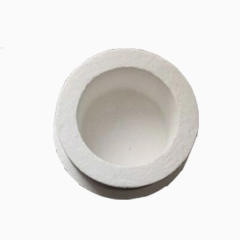
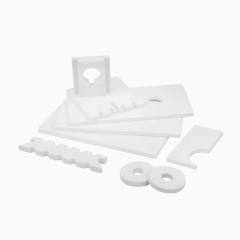
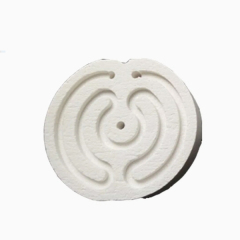
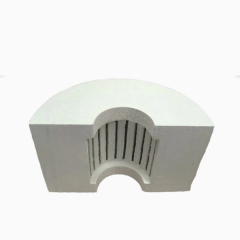
Vacuum Formed Ceramic Fiber Shapes are high-performance refractory and thermal insulation materials made primarily from high-quality ceramic fibers through vacuum forming processes. These products fully utilize the high-temperature resistance, light weight, and excellent thermal insulation properties of ceramic fibers. After special processing, they exhibit good flexibility, plasticity, and high strength. They can be customized into various complex shapes and specifications according to different usage requirements, making them ideal for high-temperature industrial applications, fire protection in construction, energy and environmental sectors, and other fields.
2. Technical Specifications
|
Item |
STD |
HP |
HA |
ZA |
HTZ |
|
Classification Temperature (℃) |
1260 (2300F) |
1260 (2300F) |
1360 (2480F) |
1360 (2480F) |
1430 (2600F) |
|
Working Temperature (℃) |
≤1050 |
≤1100 |
≤1200 |
≤1200 |
≤1350 |
|
Color |
Pure White |
Pure White |
Pure White |
Pure White |
Pure White |
|
Bulk Density (kg/m³) |
220-600 |
220-600 |
220-600 |
220-600 |
220-600 |
|
Permanent Linear Change (%) |
1000℃×24h ≤ -3 |
1100℃×24h ≤ -3 |
1200℃×24h ≤ -3 |
1200℃×24h ≤ -3 |
1350℃×24h ≤ -3 |
|
Thermal Conductivity (W/m·K) |
200℃ |
0.074 |
0.055 |
0.078 |
0.078 |
|
400℃ |
0.092 |
0.073 |
0.102 |
0.102 |
|
|
500℃ |
0.103 |
0.086 |
0.116 |
0.116 |
|
|
600℃ |
0.127 |
0.105 |
0.12 |
0.12 |
|
|
Tensile Strength (MPa) |
0.50 |
0.50 |
0.50 |
0.50 |
0.50 |
|
Chemical Composition (%) |
Al₂O₃ |
45–46 |
47–49 |
52–55 |
45–46 |
|
Al₂O₃+SiO₂ |
97 |
99 |
99 |
– |
|
|
Al₂O₃+SiO₂+ZrO₂ |
– |
– |
– |
99 |
|
|
ZrO₂ |
– |
– |
– |
5–7 |
|
|
Fe₂O₃ |
≤1.0 |
≤0.2 |
≤0.2 |
≤0.2 |
|
|
Na₂O+K₂O |
≤0.5 |
≤0.2 |
≤0.2 |
≤0.2 |
|
|
Size (mm) |
As per customer drawings |
||||
|
Packaging |
Carton boxes |
||||
|
Certificates |
CE, ISO9001-2008, ISO14001-2004, SGS, ROHS, SASO, REACH |
||||
Note: Manufactured according to customer-provided drawings.

3. Key Advantages
l Excellent High-Temperature Performance: Suitable for long-term use in 1000–1400℃, with some special formulations up to 1600℃. Non-melting, non-dripping, no harmful gases.
l Efficient Thermal Insulation & Energy Saving: Very low thermal conductivity (0.03–0.04 W/m·K at room temperature), reduces heat loss in industrial furnaces and pipelines, improving energy efficiency and lowering operating costs.
l Superior Flexibility & Plasticity: Vacuum forming enables complex shapes (curved, U-shaped, ring-shaped) to fit surfaces, filling gaps, and avoiding thermal bridges. Flexible material allows easy cutting, installation, and removal.
l High Strength & Impact Resistance: Lightweight yet strong with high compressive and tear resistance, maintaining integrity under impact, vibration, or repeated assembly.
l Strong Chemical Stability: Resistant to acids, alkalis, and most chemical environments, maintaining stable physical and chemical properties even under corrosive conditions.
4. Manufacturing Process
■ Raw Material Preparation: Short ceramic fibers (3–5 mm) mixed with inorganic binder (e.g., colloidal silica) at a ratio of 1:0.2–0.5 to form 15–25% solid content slurry.
■ Vacuum Forming: Slurry poured into porous molds and dehydrated under -0.08 to -0.1 MPa vacuum, aligning fibers to form preforms.
■ Drying & Curing: 80–120℃ for 12–24 hours to evaporate water and partially cure binder.
■ High-Temperature Sintering: Heat treatment at 800–1200℃ for 2–4 hours, achieving fiber sintering and 3–8% shrinkage.
5. Applications
✅ High-Temperature Furnace Lining: Aluminum melting furnaces (700–900℃), reduces weight by 60% and saves 15–30% energy compared to traditional refractory bricks.
✅ Aerospace Thermal Protection: Rocket engine nozzle insulation, withstands instantaneous 2000℃ gas flow.
✅ Automotive Exhaust Systems: Turbocharger heat shields, reducing compartment temperature by 50–80℃.
✅ Semiconductor Equipment: Wafer heat treatment jigs, maintaining ±0.1 mm dimensional stability at 1200℃.
6. Usage Considerations
Installation: Leave 0.5–1% thermal expansion gap (8–10 mm/m for 1600℃ products).
Dust Control: Particle concentration <1 mg/m³; operators wear P100 respirators.
Maintenance: Check surface hardness every 2000 hours; replace if Shore hardness drops >15%.

7. Future Trends
Composite Structures: Reinforced with carbon fiber or metal mesh for enhanced mechanical impact resistance.
Nano Coatings: Al₂O₃ nano coating to raise service temperature to 1700℃.
Digital Forming: 3D printing to create gradient porosity structures, optimizing insulation-to-strength ratio.
Vacuum Formed Ceramic Fiber Shapes are driving high-temperature industrial equipment toward lightweight and high-efficiency solutions, including applications in hydrogen fuel cell thermal management, reducing heat-end component weight by over 40%. Advances in manufacturing may enable use in nuclear energy and deep space exploration environments.

8. FAQ
Q1: What is the typical production lead time for Vacuum Formed Ceramic Fiber Shapes?
A1: For standard products, 3–7 working days; customized complex shapes may take 10–15 working days.
Q2: Can products be customized in shape and size?
A2: Yes, according to customer drawings or requirements.
Q3: Does flexibility affect product strength?
A3: No. Despite flexibility, the internal fiber structure is dense, providing high compressive and tear resistance even under repeated bending or external force.

