










Description
Review
Description
1. Product Overview
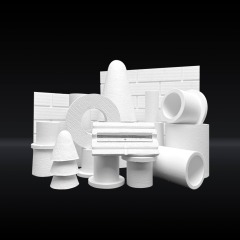
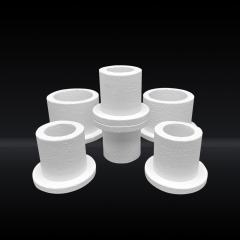
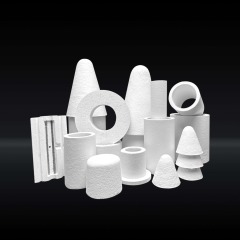
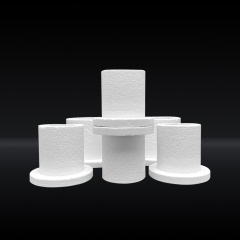
High-temperature insulating ceramic fiber shaped components are customized refractory insulation products made from high-purity ceramic fiber bulk through wet vacuum forming or compression molding processes.
They overcome the shape limitations of traditional flat materials and can be precisely manufactured into complex shapes with high accuracy and structural stability, according to equipment design and operating conditions.
In the international market, these components are widely used to replace expensive and crack-prone monolithic refractory bricks. Especially in complex areas such as corners, bends, nozzles, inspection ports, and furnace doors, customized ceramic fiber shapes ensure seamless fitting and precise installation, significantly reducing heat loss.
2. Key Advantages & Features
■ Excellent High-Temperature Resistance
Continuous working temperature: 1000°C–1430°C
Stable under thermal shock without structural collapse
Continuous working temperature: 1000°C–1430°C
Stable under thermal shock without structural collapse
■ Lightweight & High Strength
Only 1/5 the density of traditional refractory bricks
Compressive strength up to 0.5–1.0 MPa
Only 1/5 the density of traditional refractory bricks
Compressive strength up to 0.5–1.0 MPa
■ Low Thermal Conductivity & High Insulation Efficiency
Thermal conductivity: 0.08–0.18 W/m·K
Over 20% better energy-saving performance than traditional materials
Thermal conductivity: 0.08–0.18 W/m·K
Over 20% better energy-saving performance than traditional materials
■ Chemical Resistance & Thermal Shock Resistance
Resistant to acids, alkalis, and molten metal splashes
Withstands rapid temperature changes without cracking
Resistant to acids, alkalis, and molten metal splashes
Withstands rapid temperature changes without cracking
■ Environmentally Friendly
Asbestos-free and non-toxic
Compliant with RoHS and REACH standards
Asbestos-free and non-toxic
Compliant with RoHS and REACH standards
3. Technical Parameters
| Item | Value |
| Working Temperature | 1000–1430°C |
| Density | 200–450 kg/m³ |
| Thermal Conductivity (800°C) | 0.12 W/m·K |
| Compressive Strength | 0.5–1.0 MPa |
| Linear Shrinkage (24h) | ≤3% |
4. Procurement Process
01 Drawing / Sample Submission
Customer provides drawings or samples with technical requirements
Customer provides drawings or samples with technical requirements
02 Technical Evaluation
Feasibility analysis and process confirmation
Feasibility analysis and process confirmation
03 Mold Development & Sampling
Tooling production and sample testing
Tooling production and sample testing
04 Sample Approval
Customer validation and optimization
Customer validation and optimization
05 Mass Production & Delivery
Quality-controlled production and on-time delivery
Quality-controlled production and on-time delivery
We provide full-process support from design to delivery.
5. FAQ
Q1: Can the products be reused?
A: Yes, depending on working conditions such as temperature and stress.
A: Yes, depending on working conditions such as temperature and stress.
Q2: Lead time for customization?
A: Standard: 7 days; complex shapes: 15–20 days.
Q3: Are they fragile during transport?
A: Protected by customized packaging.
Q4: Installation method?
A: Anchors, adhesives, or mechanical fixing.
Q5: Surface treatment required?
A: Optional coatings available (hardening, waterproof, anti-corrosion).
Review
Review
Send your message to us

