










1. Introduction
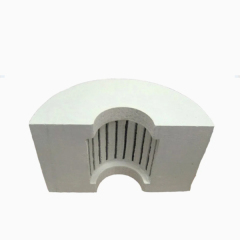
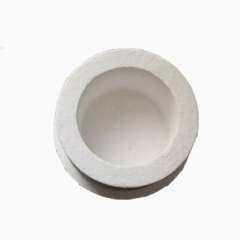
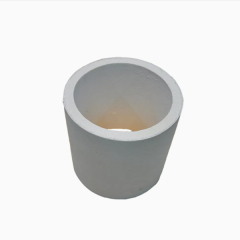
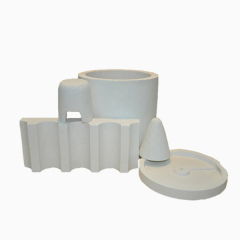
Custom inorganic ceramic fiber shapes feature precise dimensions and stable structures, and can be manufactured to match complex thermal equipment designs. They are widely used in metallurgy, casting, heat treatment, power generation, ceramics, and glass industries, serving functions such as insulation, support, flow guidance, sealing, and erosion protection. Unlike traditional ceramic fiber boards, these shapes offer higher mechanical strength and structural integrity and can be made into tubes, elbows, corrugations, cones, arcs, boxes, or blocks. They are an ideal replacement for refractory bricks or heavy insulation materials.
2. Manufacturing Process and Materials
Shapes are typically produced using three steps:
Slurry Preparation: Mixing ceramic fiber wool, high-purity water, and inorganic binders (silicates, aluminates, alumina gels, etc.).
Materials are available for different temperature ratings: 1260, 1400, zirconia-containing, and chrome-containing types.
3. Product Features
(1) Excellent high-temperature stability (up to 1350°C) and thermal shock resistance
(2) Precise dimensions and flexible customization (tolerance ≤ ±1 mm)
(3) Low dust and non-fragile surface, suitable for clean environments
(4) Lightweight yet strong structural support (bulk density 250–600 kg/m³)
(5) Superior insulation (thermal conductivity @1000°C ≤ 0.18 W/m·K)
(6) Inorganic and environmentally safe (no organics, odorless, RoHS & REACH compliant)
(7) Resistant to wind and molten metal erosion

4. Common Types & Examples
Cylindrical/Rectangular tubes (thermocouple protection sleeves, insulation sleeves)
Elbows/Tees (pipe corner covers)
Arcs/Half-circles (furnace covers, radiation plates)
Cones/Domes (steel ladle covers, crucible exteriors)
Precast blocks/modules (high-temperature insulation bricks, furnace modules)
Boxes, corrugated panels, U-shaped channels, stepped or complex parts
Material Grades:
l 1260 (standard white): Working temp 1050–1150°C
l Zirconia 1350: Improved strength and erosion resistance
l High Alumina 1400: Higher temperature tolerance, suitable for aluminum contact
l Soluble type: Low biological persistence, EU export-compliant
5. Typical Applications
ü Metallurgy & Casting: Ladle covers, aluminum ladle lids, troughs, insulation sleeves, preheating covers
ü Industrial Heat Treatment: Roller kiln doors, furnace covers, heater insulation shells, radiation panels
ü Petrochemical Equipment: Reactor shells, pipe elbows, exhaust expansion joint liners
ü Glass & Ceramics: Glass tank furnace covers, insulation rings, flow guide components, furnace linings
ü Power & Renewable Energy: High-temperature battery covers, electric heater lining, plasma equipment protection
ü Aerospace & Defense: Missile launch platform insulation, engine thermal protection shells, cabin insulation modules
6. Packaging & Transportation
Ø Custom packaging in cartons, wooden boxes, or pallets
Ø Shockproof padding for fragile areas
Ø Labels include product model, drawing number, material type, and serial number
Ø Store in dry, ventilated areas to prevent moisture or deformation
7. Customization Service Process
A. Client provides design or sample
B. Engineering evaluates feasibility and material recommendations
C. Mold fabrication and sample trial
D. Mass production, inspection, packaging, and shipping
E. Design assistance available if no drawings provided
8. SUNTHERM Advantages
n Complete ceramic fiber product manufacturing capabilities (wool → board → shapes → composites)
n Multiple vacuum forming lines capable of producing large shapes (up to 1200×1000×500 mm)
n Extensive industry experience and familiarity with exports, project customization standards
n Fast response: sample production in 3–5 days, guaranteed delivery
n Comprehensive quality control, with material certificates and inspection reports

9. FAQ
Q1: Can shapes be used for molten metal contact?
A1: Yes. Special compositions (high zirconia, high alumina) improve corrosion resistance for aluminum/steel applications. Surface hardening or anti-penetration coatings are recommended.
Q2: Minimum order quantity? Can we make just a few samples?
A2: Small batch orders are supported; one mold can produce several or single samples.
Q3: Will the shapes shed fibers like boards?
A3: No. Dense surfaces and firm edges release almost no fibers, suitable for clean environments like battery or semiconductor equipment.

