


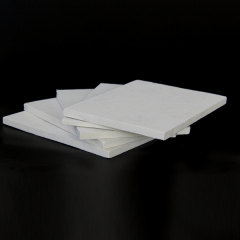


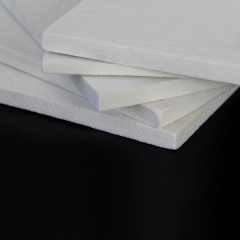


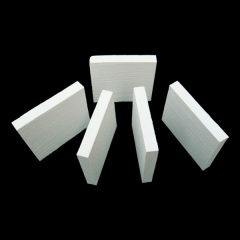


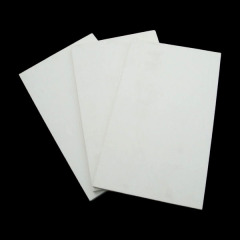


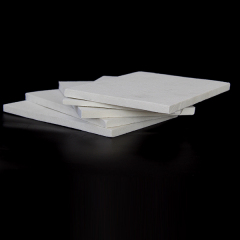


The board has a dense structure, high mechanical strength, and excellent machinability. It is widely used in various industrial furnaces, thermal equipment, and insulation systems, especially in applications requiring high dimensional stability and structural strength
2. Structure & Manufacturing Process
High-strength ceramic fiber boards are manufactured from high-purity alumina (Al₂O₃) and silica (SiO₂) raw materials using a wet vacuum forming process.
The production process includes:
- Vacuum forming
- Drying
- Cutting
- Grinding
This results in a uniform structure and smooth surface.
Depending on application requirements, reinforcing fibers or special binders can be added to enhance mechanical strength and environmental adaptability.
3. Product Advantages
■ High-Temperature Stability
Maintains structural integrity under prolonged high-temperature conditions without deformation or powdering.
■ Excellent Thermal Insulation Performance
Low thermal conductivity effectively reduces heat loss and improves energy efficiency.
■ Strong Erosion Resistance
Resistant to high-velocity airflow, suitable for harsh industrial environments.
■ Easy Processing and Installation
Can be sawed, cut, drilled, and machined easily, allowing flexible on-site installation.
■ Excellent Chemical Stability
Resistant to acids and alkalis, suitable for chemically aggressive environments.
■ Environmentally Friendly and Safe
Asbestos-free, non-toxic, compliant with EU RoHS and REACH standards.
4. Typical Applications
▶ Industrial furnace linings (metallurgical furnaces, heat treatment furnaces, glass furnaces)
▶ Hot air duct linings
▶ Backup insulation systems for thermal equipment
▶ Furnace doors and covers sealing structures
▶ Power boiler insulation layers
▶ Flue fireproof insulation
▶ Fire doors and building fire protection partitions

5. Technical Parameters
|
Item |
STD |
HP |
HA |
ZA |
HTZ |
||||
|
Classification Temp (℃) |
1260 (2300F) |
1260 (2300F) |
1360 (2480F) |
1360 (2480F) |
1430 (2600F) |
||||
|
Working Temp (℃) |
≤1050 |
≤1100 |
≤1200 |
≤1200 |
≤1350 |
||||
|
Color |
Pure White |
Pure White |
Pure White |
Pure White |
Pure White |
||||
|
Bulk Density (Kg/m3) |
280---600 |
280---600 |
280---600 |
280-600 |
280---600 |
||||
|
Permanent Linear change (%) |
1000℃X24h≤ -3 |
1100℃X24h≤ -3 |
1200℃X24h≤ -3 |
1200℃X24h≤ -3 |
1350℃X24h≤ -3 |
||||
|
Thermal Conductivity (w/m.k) |
200C |
0.074 |
0.055 |
0.078 |
0.078 |
0.078 |
|||
|
400C |
0.092 |
0.073 |
0.102 |
0.102 |
0.102 |
||||
|
500C |
0.103 |
0.086 |
0.116 |
0.116 |
0.116 |
||||
|
600C |
0.127 |
0.105 |
0.12 |
0.12 |
0.12 |
||||
|
Tensile Strength (Mpa) |
0.50 |
0.50 |
0.50 |
0.5 |
0.50 |
||||
|
Chemical Composition (%) |
AL2O3 |
45—46 |
47—49 |
52—55 |
45-46 |
39—40 |
|||
|
AL2O3+SIO2 |
97 |
99 |
99 |
- |
- |
||||
|
AL2O3+SIO2+ZrO2 |
- |
- |
- |
99 |
99 |
||||
|
ZrO2 |
- |
- |
- |
5-7 |
15—17 |
||||
|
Fe2O3 |
≤ 1.0 |
≤0.2 |
≤0.2 |
≤0.2 |
≤0.2 |
||||
|
Na2O+K2O |
≤ 0.5 |
≤ 0.2 |
≤ 0.2 |
≤0.2 |
≤ 0.2 |
||||
|
Size(mm) |
Length:600 & 900 & 1200; Width:300 & 600 & 1000 & 1200 Thickness: 3-100; As customers ‘requirements. |
||||||||
|
Package |
Cartons or as customer’s requirement. |
||||||||
|
Certificate |
CE,ISO9001-2008; ISO14001-2004,SGS, ROHS,SASO, REACH |
||||||||
6. Installation Guidelines
Material Inspection
- Verify size, thickness, and specifications
- Ensure no cracks, delamination, or damage
Surface Requirements
- Clean, flat, dry surface
- Free from oil, rust, or loose particles
- Metal shells must be pre-treated
Tools Preparation
- Use electric or pneumatic cutting tools (angle grinder, cutter)
- Prepare PPE (mask, goggles, gloves)
(2) Installation Key Points
Cutting & Machining
- Cut slowly along marked lines to prevent edge chipping
- Use low-speed drilling and back support
Fixing Method
- Welding anchors + mechanical fastening
- Anchor spacing: 200–300 mm
- Multi-layer installation must be staggered
Joint Treatment
- Tight joints required
- Fill gaps with ceramic fiber blanket or slurry
- Use high-temperature adhesive for >1000°C
Expansion Allowance
- Leave 1–2 mm expansion gap
- Use expansion joints for large areas
(3) Safety & Operation
- Wear dust mask (N95 or above) and goggles
- Avoid direct skin contact
- Ensure proper ventilation
- Keep away from open flames
(4) Post-Installation Inspection
Visual Inspection
- Check flatness and fixing stability
- Ensure no gaps or uncovered areas
Initial Heating (Dry-Out)
- Gradual heating recommended
- Hold at 300–600°C to cure binder
(5) Important Notes
- High hardness but brittle — handle carefully
- Store vertically
- Use enhanced boards for corrosive environments
- Consult technical team for complex structures
7. FAQ
Q1: What temperature can the board withstand?
A1: The working temperature ranges from 1050°C to 1350°C depending on the grade.
Q2: Advantages over traditional insulation materials?
A2: Lower thermal conductivity, higher temperature resistance, better mechanical strength, and improved structural stability.
Q3: Is it environmentally compliant?
A3: Yes, asbestos-free and compliant with RoHS and REACH standards. Bio-soluble options are also available.
Q4: What should be noted during installation?
A4: Ensure clean surface, proper anchoring, staggered joints, and allow expansion gaps. Use protective equipment.
Q5: When should the board be replaced?
A5: When cracks, delamination, powdering, melting, or significant performance degradation occurs.

