


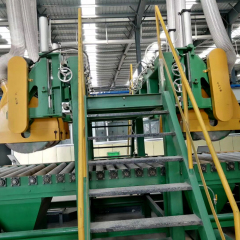


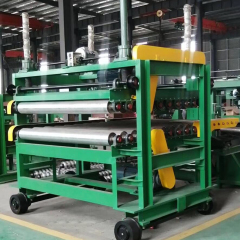


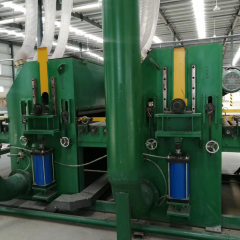


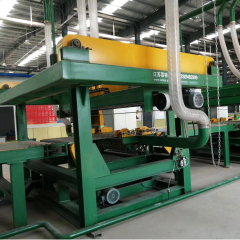


1. Main Components of the Mineral Wool Production Line
Feeding System: Comprises storage hoppers, feeders, belt conveyors, etc., capable of automatic dosing, selection, and transportation of raw materials.
Electric Furnace Melting System: The core equipment is the electric furnace, which uses electrical energy supplied through electrodes to melt the raw materials at high temperatures.
Fiber Forming System: Mainly includes equipment such as centrifuges and blowing fans to transform high-temperature melts into mineral wool fibers.
Forming and Curing System: Consists of a pendulum machine for cotton mat formation, molds, curing ovens, etc. Mineral wool fibers are layered into a uniform cotton mat, and the binder is cured in the oven, forming mineral wool boards with stable strength and shape.
Cutting and Packaging System: Includes cutting equipment and packing machines. The cured mineral wool boards are cut into specified sizes and packed for shipment.
Control System: A DCS control system monitors and regulates temperature, pressure, flow, speed, and other production parameters in real-time.
2. Technical Advantages
Energy Saving and Environmental Protection: Overall energy consumption of the SUNTHERM mineral wool production line is reduced by more than 20%. CO₂ emissions decrease by 10%, and SO₂ emissions drop by 30%. The line saves approximately 4,100 tons of standard coal annually, with SO₂, NOₓ, and dust emissions reduced by 35%, 20%, and 30%, respectively.
High Production Efficiency: The maximum daily output of SUNTHERM electric furnace mineral wool lines reaches 330 tons, with an annual capacity of 100,000 tons. The Lyoyang line has a daily output of 150 tons and an annual capacity of 50,000 tons.
Excellent Product Quality: The alkalinity of products from the SUNTHERM mineral wool line reaches 2.0 or above, and the thermal conductivity of exterior wall products is only 0.036 W/(m·K).
High Level of Automation: The entire production line can be controlled via the DCS system, reducing manual intervention, improving production stability, and ensuring consistent product quality.
3. Applications
Building Insulation: Used for exterior walls, roofs, and fireproof insulation belts, enhancing thermal insulation and fire safety.
Industrial Applications: Serves as thermal insulation for industrial equipment and pipelines, reducing heat loss and energy consumption. Also suitable for insulating industrial roofs, walls, and fireproof partitions.
Other Applications: Widely applied in chemical, power, transportation, and other industries for corrosion protection, chemical equipment insulation, power pipeline insulation, and fireproof thermal insulation for ships.
4. FAQ
Q1: Is the investment cost for an electric furnace mineral wool production line high?
A1: Costs depend on the scale and equipment configuration. Medium-scale lines, including equipment, factory, and other expenses, typically range from 100–300 million RMB.
Q2: Is maintenance of the electric furnace mineral wool line complicated?
A2: Not at all. It requires routine equipment inspections, replacement of worn parts, and ensuring proper lubrication, cleaning, and system stability.
Q3: What is the production capacity of the electric furnace mineral wool line?
A3: Production capacity varies by scale. Large-scale lines can produce up to 330 tons per day, with an annual output of 100,000 tons.

