










High Efficiency and Superior Quality
SUNTHERM Group’s coke oven rock wool production line boasts strong production capacity and can be customized to meet your specific needs, ranging from small-scale lines producing several thousand tons per year to large-scale lines producing tens of thousands of tons. With advanced equipment and processes, the rock wool products produced feature high quality, uniform fibers, excellent thermal insulation, sound absorption, and fire resistance, making them widely applicable in construction, industrial, and shipbuilding sectors.
1. Mature Process, Stable Operation
(1) Raw Material Handling: Carefully selected basalt, dolomite, slag, and other high-quality minerals are used as the main raw materials. After strict crushing, screening, and other pre-processing steps, the materials achieve uniform particle size. High-quality coke is used as fuel, and a precise electronic automatic feeding system delivers raw materials to the cupola furnace in exact proportions, laying a solid foundation for stable production.
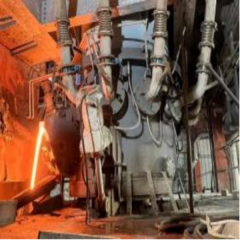
(2) High-Temperature Melting: In the cupola furnace, the coke is fully combusted, generating temperatures of 1450–1600°C, which quickly melt the raw materials into a uniform molten state. Advanced combustion control technology ensures efficient fuel burning and even heat distribution, guaranteeing consistent molten quality.
(3) Fine Fiber Formation: The molten material flows from the cupola furnace to a high-speed centrifuge via specially designed chutes. Under the strong centrifugal force, the molten material is instantly spun into fibers with diameters of only 3–5 microns. Simultaneously, additives such as phenolic resin, water repellents, and anti-dust oils are precisely sprayed to impart excellent properties to the fibers.
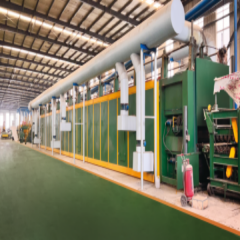
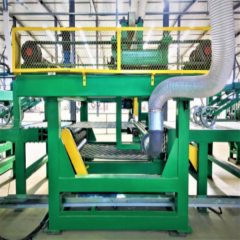
(4) Precise Collection and Forming: Fibers with additives are blown out by the centrifuge’s air system into the collection chamber. In the chamber, collection drums use negative pressure generated by the exhaust system to evenly deposit fibers on their surfaces, forming fibrous mats. The mats are then conveyed to a shaking device, which evenly lays the fibers on the conveyor. After reaching the desired layers, the mats enter a three-dimensional corrugation machine, where compression and folding significantly enhance the tensile strength of the rock wool boards. Next, the mats move into a curing oven, where under controlled temperature and time, the binder solidifies, bonding the fibers together to form boards with stable shape and strength.
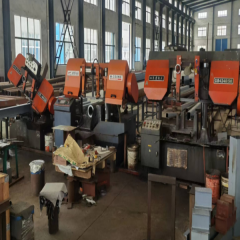
(5) Post-Processing and Packaging: Cured boards are cooled to room temperature through a cooling system and cut precisely to required dimensions using high-precision cutting equipment. After passing quality inspection, the products are packaged by automated equipment and stacked neatly using mechanical handling systems, ready for storage and transportation.

2. Operation Precautions
(1) Before Start-Up: Inspect all equipment connections, especially the furnace body, pipes, and valves of the cupola furnace, ensuring no looseness or leaks. Check electrical systems, including control panels and motor wiring, to confirm stable voltage and proper grounding. Conduct empty-load testing of the raw material feeding system, checking conveyor alignment and material flow. Verify the cooling water system for proper pressure, unobstructed pipes, and even flow distribution.
(2) During Operation: Closely monitor the furnace combustion, including coke condition, flame color, and temperature fluctuations. Stable furnace temperature is critical to fully melt the raw materials. Regularly check centrifuge parameters such as speed and vibration. Any abnormal noise or excessive vibration should prompt immediate shutdown and inspection. Strictly monitor the spraying system to ensure uniform and stable distribution of additives, preventing quality inconsistencies. Always pay attention to the sounds, temperature, and odor of equipment during operation; stop and troubleshoot if abnormalities occur.
(3) Maintenance: Regularly remove slag from the furnace to maintain combustion efficiency and furnace lifespan, typically once every 1–2 weeks depending on production. Inspect and replace filter bags in baghouse dust collectors every 2–3 months or as needed. Lubricate moving parts such as motors, gearboxes, and bearings according to manufacturer guidelines. Perform periodic calibration and maintenance of the control system, including electronic metering, temperature, and pressure sensors, to ensure accuracy and stability.
3. Environmental Protection and Green Production
(1) Waste Gas Treatment: Equipped with advanced desulfurization and denitrification equipment using limestone–gypsum wet desulfurization and selective catalytic reduction (SCR), efficiently removing SO₂, NOₓ, and other harmful gases. High-performance bag filters capture dust at emission points, ensuring compliance with emission standards. Organic waste gases are treated using activated carbon adsorption for full purification.
(2) Wastewater Recycling: A comprehensive wastewater treatment station collects cooling water and equipment cleaning water. Through sedimentation, filtration, oil separation, and neutralization, impurities are removed, and treated water is recycled for production, reducing water consumption and discharge.
(3) Waste Residue Utilization: Waste residues, including furnace slag and dust from collection systems, are recycled. Slag can be used in cement, bricks, or road base materials; collected dust can be reused in rock wool production. Any non-recyclable waste is disposed of according to environmental regulations.
(4) Noise Control: Low-noise equipment is prioritized. Noise-dampening bases, silencers, and sound-absorbing materials are used to reduce noise levels and minimize impact on operators and surrounding environment.
4. Professional Team and Dedicated Service
We have an experienced professional team providing comprehensive services from production line design and installation to maintenance and technical upgrades. We customize coke oven rock wool production lines according to your site conditions and requirements, ensuring efficient and stable operation while maximizing economic and social benefits.
For inquiries or further information about our coke oven rock wool production line, please feel free to contact us – we are ready to assist you!

5. FAQ
Q1: What specifications of rock wool products can the coke oven production line produce?
A1: It can produce rock wool boards and mats of different densities, thicknesses, and sizes, suitable for exterior wall insulation, industrial equipment insulation, and other applications.
Q2: What key checks are required before starting the equipment?
A2: Check that all equipment connections are secure, electrical system voltage and grounding are normal, the raw material feeding system runs empty-load smoothly, and the cooling water system has proper pressure and unobstructed pipes.
Q3: How to ensure stable product quality during operation?
A3: Closely monitor furnace temperature to ensure complete melting of raw materials, maintain stable centrifuge operation, and precisely control the spraying system to ensure uniform application of additives.

