










1. Product Overview
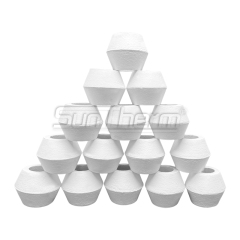
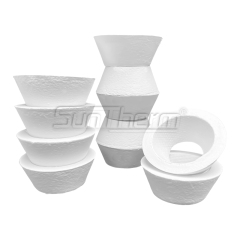
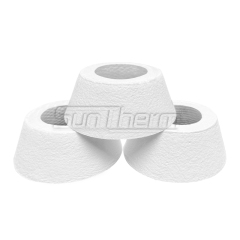
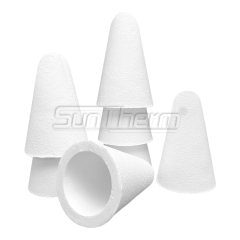
1600°C polycrystalline mullite ceramic fiber vacuum formed shapes are high-performance refractory insulation products manufactured from high-purity alumina (Al₂O₃). Through advanced processes including high-temperature melting, fiberizing, vacuum forming, and crystallization, the material develops a stable polycrystalline mullite structure.
Compared with standard ceramic fiber boards or blankets, these vacuum formed shapes can be precisely engineered to match complex equipment geometries. This makes them ideal for high-temperature insulation, sealing, and protection in areas where conventional materials are difficult to install or ineffective.
With a maximum continuous operating temperature of up to 1600°C, these products are widely used in demanding industrial environments requiring long-term thermal stability, dimensional accuracy, and structural reliability.
2. Manufacturing Process & Structural Characteristics
The products are produced using vacuum forming technology, where ceramic fiber slurry is molded into specific shapes using precision molds. After forming, the components undergo controlled drying and high-temperature crystallization.
This process ensures:
-
High dimensional accuracy and consistency
-
Uniform density distribution
-
Smooth surface finish
-
Excellent structural integrity
Internally, the material consists of a porous fiber network that traps air, effectively reducing heat transfer through conduction and convection. The polycrystalline mullite structure further enhances high-temperature resistance and minimizes shrinkage during long-term operation.
3. Key Performance Advantages
(1)Excellent High-Temperature ResistanceDesigned for continuous use up to 1600°C, suitable for extreme thermal environments.
(2)Low Thermal Conductivity
Minimizes heat loss and improves overall energy efficiency.
(3)Outstanding Structural Stability
Maintains shape and integrity without deformation or collapse under prolonged high temperatures.
(4)Superior Thermal Shock Resistance
Capable of withstanding rapid temperature changes and cyclic heating conditions.
(5)Complex Shape Adaptability
Custom-designed to fit intricate equipment structures and confined spaces.
(6)Enhanced Sealing Performance
Provides effective sealing for high-temperature systems, reducing heat leakage.
4. Technical Specifications
| Property | Unit | Value |
| Classification Temperature | °C | ≤1600 |
| Density | kg/m³ | 200–350 |
| Thermal Conductivity | W/m·K | 0.18 (800°C) |
| Compressive Strength | MPa | ≥0.5 |
| Linear Shrinkage | % | ≤2 |
| Chemical Composition | % | Al₂O₃ ≥72% |
| Combustibility | — | Non-combustible |
5. Product Types & Customization Capabilities
Polycrystalline ceramic fiber vacuum formed shapes can be customized into a wide variety of forms, including:
-
Complex-shaped boards and curved components
-
Pipe covers and elbows
-
Furnace door seals
-
Insulation housings and covers
-
Inserts and protective components
-
High-temperature gaskets and sealing elements
Customization options include:
-
Manufacturing according to drawings
-
Non-standard sizes and geometries
-
Adjustable density and structure
-
Surface reinforcement or composite layers
6. Typical Applications
These products are widely used in industrial systems requiring precise insulation and high-temperature performance:
-
Industrial furnaces and kilns
-
Metallurgical equipment
-
Petrochemical processing units
-
Heat treatment systems
-
Furnace door and sealing structures
-
High-temperature energy and environmental equipment
They are particularly suitable for complex areas where standard insulation materials cannot provide effective coverage or sealing.
7. Installation & Usage Guidelines
Vacuum formed shapes can be installed using adhesive bonding, mechanical fixing, or embedded assembly methods.
Recommendations:
-
Ensure clean and dry installation surfaces
-
Combine with metal supports for enhanced stability
-
Use higher-density products in hot-face areas
Safety precautions:
Operators should wear protective equipment to avoid inhalation of fiber dust.
8. Comparative Advantages
| Item | Polycrystalline Shapes | Standard Fiber Products |
| Max Temperature | 1600°C | 1260–1400°C |
| Structural Adaptability | Excellent | Limited |
| Stability | High | Medium |
| Service Life | Long | Moderate |
9. Quality Control System
Strict quality control is applied throughout the production process:
-
Raw material purity inspection
-
Dimensional accuracy control
-
Thermal performance testing
-
High-temperature stability testing
-
Environmental compliance (RoHS / REACH)
10. Packaging, Transportation & Services
Packaging:
Cartons or pallets with moisture-proof protection.
Transportation:
Suitable for export, avoid compression during transit.
Services:
-
Free samples
-
Technical consultation
-
Custom design solutions
-
After-sales support
11. FAQ
Q1: What is the difference between vacuum formed shapes and standard boards?
A1: Vacuum formed shapes are customized for specific structures, offering better fit, sealing, and performance in complex areas.
Q2: Can you manufacture according to drawings?
A2: Yes, full customization based on customer designs is available.
Q3: What temperature range are these products suitable for?
A3: They are suitable for continuous operation up to 1600°C in high-temperature environments.

