










1. Product Overview
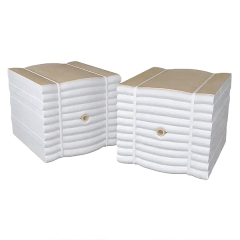
The 1600°C polycrystalline mullite ceramic fiber module is a premium high-temperature insulation module designed for industrial furnace lining systems. Manufactured from high-purity alumina (Al₂O₃) through high-temperature melting, fiberizing, and crystallization processes, it forms a stable polycrystalline mullite structure.
Compared with standard ceramic fiber modules, this high temperature ceramic fiber module offers significantly improved thermal stability, reduced shrinkage, and extended service life under extreme conditions up to 1600°C.
It is widely used as a refractory insulation module for furnaces, kilns, and thermal processing equipment, delivering excellent energy efficiency and long-term performance.
2. Structure & Working Principle
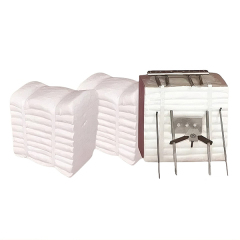
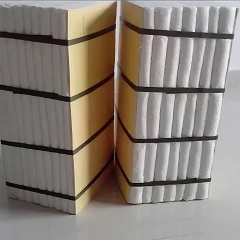
This ceramic fiber insulation module is pre-compressed and assembled into block units with anchoring systems. After installation, the modules expand to form a seamless and dense insulation lining.
Key working advantages:
-
Eliminates gaps between modules
-
Reduces heat loss and thermal bridging
-
Enhances furnace sealing performance
-
Improves overall insulation efficiency
The internal porous fiber structure traps air, minimizing heat transfer and improving insulation performance in high temperature environments.
3. Key Features & Performance Advantages
✔ High Temperature Resistance up to 1600°C
Suitable for extreme high-temperature furnace environments.
✔ Low Thermal Conductivity
Ensures excellent insulation and reduces energy consumption.
✔ Excellent Thermal Shock Resistance
Ideal for applications with frequent heating and cooling cycles.
✔ Pre-compressed Modular Design
Quick installation and strong sealing performance.
✔ High Structural Stability
Maintains shape and integrity under long-term high temperature exposure.
✔ Long Service Life
Outperforms standard ceramic fiber modules in durability.
4. Technical Specifications
| Item | Unit | Value |
| Classification Temperature | °C | 1600 |
| Density | kg/m³ | 192 / 220 / 240 |
| Thermal Conductivity | W/m·K | 0.20 (800°C) |
| Tensile Strength | MPa | ≥0.4 |
| Linear Shrinkage | % | ≤2 |
| Chemical Composition | % | Al₂O₃ ≥72% |
| Combustibility | — | Non-combustible |
5. Specifications & Customization
We offer full customization for industrial furnace applications:
-
Module thickness: 100–300 mm
-
Standard and custom sizes available
-
Multiple density options
-
Anchoring systems: stainless steel / alloy
-
Folding or stacked structure design
-
Custom furnace lining solutions
6. Applications
This high temperature insulation module is widely used in:
-
Industrial furnaces and kilns
-
Heat treatment furnaces
-
Metallurgical processing equipment
-
Petrochemical cracking furnaces
-
Waste incineration systems
-
New energy high-temperature equipment
7. Installation Guidelines
Modules are installed using anchoring systems directly onto furnace shells.
Recommendations:
-
Use staggered arrangement for better sealing
-
Select high-density modules for hot-face areas
-
Ensure clean and dry installation surface
-
Use proper anchors for high stability
8. Advantages vs Standard Modules
| Item | Polycrystalline Module | Standard Module |
| Max Temperature | 1600°C | 1260–1400°C |
| Stability | Excellent | Medium |
| Shrinkage | Low | Higher |
| Service Life | Long | Medium |
| Energy Efficiency | High | Moderate |
9. Quality Control
Strict quality inspection ensures consistent performance:
-
Raw material purity testing
-
Fiber structure analysis
-
Thermal conductivity testing
-
High-temperature shrinkage testing
-
Environmental compliance (RoHS / REACH)
10. Packaging & Storage
-
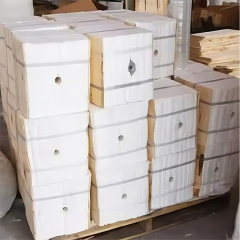
Carton or pallet packaging
-
Moisture-proof protection
-
Suitable for sea transportation
-
Store in dry, ventilated conditions
11. Technical Support
-
Free sample supply
-
Furnace lining design consultation
-
Customized solutions
-
After-sales technical support
12. FAQ
Q1: What is the advantage of ceramic fiber modules over blankets?
A1: Modules are pre-compressed, providing better sealing, faster installation, and improved insulation performance for large furnace linings.
Q2: Can it be used in extreme high-temperature environments?
A2: Yes, it is designed for continuous use up to 1600°C, ideal for demanding industrial conditions.
Q3: Do you offer customized furnace lining solutions?
A3: Yes, we provide full customization including size, density, and anchoring systems.

