


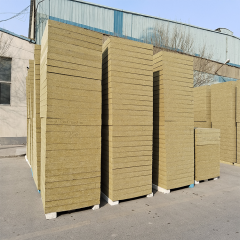


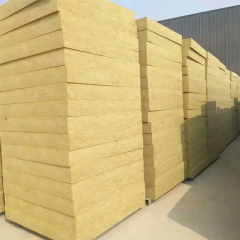


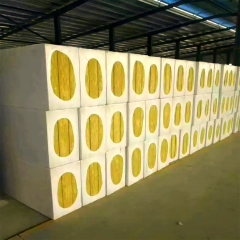


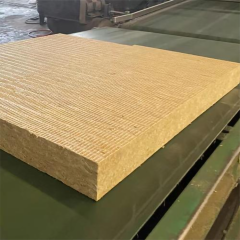


Raw Materials and Composition
The main raw materials used are basalt, pyroxene, and other natural rocks. Through fibrillation at high-temperature melting, artificial inorganic fibers are produced, with primary components including silica (SiO₂), alumina (Al₂O₃), calcium oxide (CaO), magnesium oxide (MgO), etc. Small amounts of special binders, dust-proof oils, and other additives are also added to improve product performance and processing technology.
Chemical Composition Parameters
| Description | High-Quality Mineral Wool Board |
| Density (kg/m³) | 50–160 |
| Melting Temperature (℃) | >1000 |
| Compressive Strength (MPa, 10% deformation) | ≥40 |
| Tensile Strength (kPa) | ≥80 |
| Acid Resistance Index | ≥1.8 |
| Water Repellency (%) | ≥98 |
| Hygroscopicity (%) | ≤1.0 |
| Water Absorption (kg/m², partial immersion) | Short-term (24h) ≤1.0, Long-term (28 days) ≤3.0 |
| Combustibility | Non-combustible A1 |
| Permanent Linear Shrinkage (%) | 750℃×0.5h ≤8 |
| Mass Loss (%) | 750℃×0.5h ≤10 |
| Thermal Conductivity (W/m·K, 25℃) | ≤0.04 |
| Thickness Tolerance (mm) | ±3 |
| Flatness Tolerance (mm) | ≤5 |
| Standard Size (mm) | 1200×600×(25–100) |
Note: For additional technical specifications, please consult our sales manager.
Performance Characteristics
Excellent Thermal Insulation: Industrial mineral wool boards have low thermal conductivity (typically 0.03–0.044 W/(m·K)), effectively reducing heat transfer and losses. They help maintain stable temperatures for industrial buildings and equipment while reducing energy consumption.
Superior Fire Resistance: Mineral wool is a non-combustible Class A material with excellent fire resistance. It slows fire spread, providing more time for evacuation and fire control, enhancing the safety of buildings and industrial facilities.
Sound Absorption and Noise Reduction: The porous fiber structure provides good sound absorption, blocking noise transmission, reducing industrial noise pollution, improving working conditions, and protecting operators’ hearing.
High Strength and Compression Resistance: After specialized production processes, mineral wool boards have high mechanical strength and compression resistance, supporting significant weight and pressure without deformation. Suitable for roofs, wall insulation, and other load-bearing applications.
Good Chemical Stability: Resistant to most chemicals, acids, and alkalis, mineral wool maintains long-term performance even in harsh industrial environments.
Production Process
Raw Material Preparation: Basalt, pyrophyllite, and other ores are selected, crushed, sieved, and preprocessed to meet particle size requirements. Preprocessed raw materials are mixed in precise ratios and sent to the melting furnace.
High-Temperature Melting: Raw materials are heated in a furnace to 1400–1600℃, melting completely into a liquid state.
Fibrillation: The molten raw material is stretched into fine fibers using high-speed centrifugal wheels or high-pressure air streams to form mineral wool fibers.
Binder Application: Special binders are evenly sprayed onto the fibers during formation to bind them together and give them shape and strength.
Forming and Curing: Fibers with binder are fed into forming equipment to create boards of various thicknesses and specifications, then cured in a furnace to solidify the binder, ensuring strength and stability.
Cutting and Packaging: Cured boards are cut to user specifications, sized accordingly, and packaged for transport and storage.
Applications
Thermal Insulation for Industrial Buildings: Widely used in industrial facilities, warehouses, cold storage, and other buildings to insulate roofs, walls, and floors, reducing energy consumption and maintaining stable indoor temperatures.
Thermal Insulation for Industrial Equipment: Used for boilers, pipelines, reactors, and other industrial equipment to reduce heat loss, improve thermal efficiency, lower energy consumption, and protect personnel from burns.
Fireproof Insulation Zones: Acts as a fireproof barrier in industrial buildings to control fire spread and minimize fire damage. Critical in flammable or explosive industrial environments.
Sound Absorption and Noise Reduction: Installed in walls, ceilings, and other areas of noisy industrial plants to absorb and block sound, improve working conditions, and protect operators’ hearing.
FAQ
Q1: What are the advantages of mineral wool boards?
A1: They are fireproof, non-combustible, thermally insulating, and provide sound absorption and noise reduction.
Q2: Where are mineral wool boards used?
A2: Primarily for building exterior wall insulation, industrial equipment thermal insulation, and wall soundproofing.
Q3: What should be considered during installation?
A3: Avoid installation on rainy days and ensure proper sealing to prevent moisture from affecting the boards.