










Description
Review
Description
1. Product Introduction
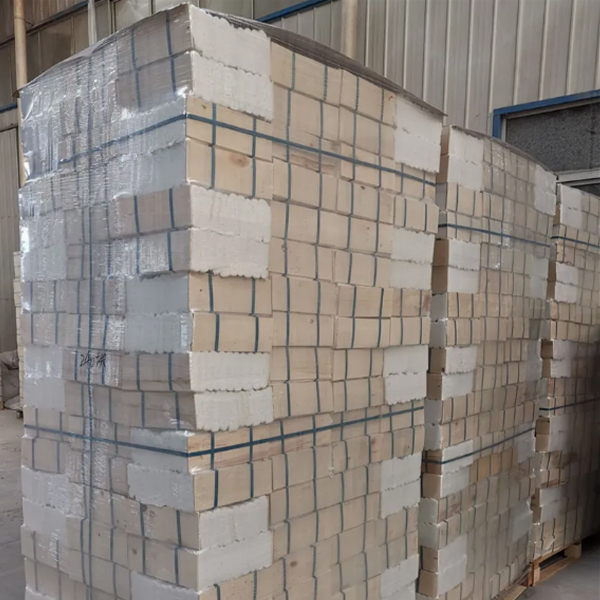
Bio-soluble ceramic fiber modules not only meet the high-temperature insulation requirements of thermal equipment but also ensure safety for humans and the environment, complying with international environmental standards for respirable fiber materials.
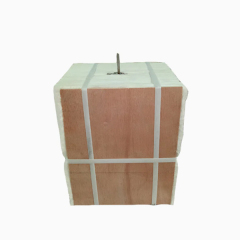
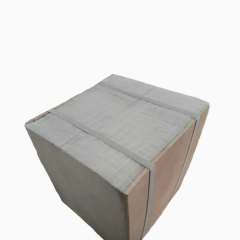
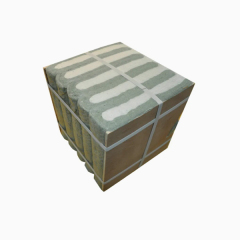
SUNTHERM bio-soluble ceramic fiber modules are manufactured from high-quality soluble long fibers, combined with precision folding and compression molding processes. The modules feature accurate dimensions, easy installation, and minimal expansion gaps. During operation, they can automatically compensate for gaps caused by furnace lining thermal shrinkage, maintaining overall furnace sealing and thermal efficiency.
2. Technical Specifications
|
Item |
1260°C Ceramic Fiber Special-shaped Parts |
|
Classification Temperature (℃) |
1260 |
|
Service Temperature (℃) |
≤1100 |
|
Permanent Linear Shrinkage (%) |
≤4 (at 950℃ × 24h) |
|
Thermal Conductivity (Average Temperature 500℃, W/(m·K)) |
≤0.153 |
|
Moisture Content (%) |
≤1 |
|
Loss on Ignition (%) |
≤8 |
|
Nominal Density (kg/m³) |
220–400 |
|
SiO₂ (%) |
60–68 |
|
CaO (%) |
25–35 |
|
MgO (%) |
4–7 |
|
Al₂O₃ (%) |
<1.0 |
Note: For information on other technical specifications of the product, please consult the company’s sales manager.
3. Product Features and Performance Advantages
▶ Eco-friendly and Safe
Bio-soluble ceramic fiber modules are made from low biopersistence fibers, which can be broken down and eliminated in the human body without causing long-term respiratory or lung damage. They fully comply with international environmental standards such as the EU Q-mark, Germany AGI Q132, and REACH, making them suitable for production environments with strict health and safety requirements.
Bio-soluble ceramic fiber modules are made from low biopersistence fibers, which can be broken down and eliminated in the human body without causing long-term respiratory or lung damage. They fully comply with international environmental standards such as the EU Q-mark, Germany AGI Q132, and REACH, making them suitable for production environments with strict health and safety requirements.
▶ Excellent High-Temperature Performance
The modules are designed to operate within a temperature range of 1000℃–1260℃, offering outstanding thermal stability and resistance to thermal shock. They do not pulverize, crumble, or deform during long-term operation, ensuring reliable industrial furnace performance.
The modules are designed to operate within a temperature range of 1000℃–1260℃, offering outstanding thermal stability and resistance to thermal shock. They do not pulverize, crumble, or deform during long-term operation, ensuring reliable industrial furnace performance.
▶Low Thermal Conductivity and Heat Capacity
The fiber arrangement in the modules is dense and uniform, resulting in a thermal conductivity far lower than traditional refractory bricks or castables. Even under high-temperature conditions, heat loss remains minimal. Moreover, the low heat capacity shortens heating time, improves thermal efficiency, and reduces energy consumption.
The fiber arrangement in the modules is dense and uniform, resulting in a thermal conductivity far lower than traditional refractory bricks or castables. Even under high-temperature conditions, heat loss remains minimal. Moreover, the low heat capacity shortens heating time, improves thermal efficiency, and reduces energy consumption.
▶Scientific Module Structure Design
Special folding techniques increase fiber bend density, creating a “pre-stressed” fit against the furnace wall after compression installation. This design effectively absorbs thermal stress and mechanical vibrations, extending the service life of the furnace lining.
Special folding techniques increase fiber bend density, creating a “pre-stressed” fit against the furnace wall after compression installation. This design effectively absorbs thermal stress and mechanical vibrations, extending the service life of the furnace lining.
▶Efficient Installation and Easy Maintenance
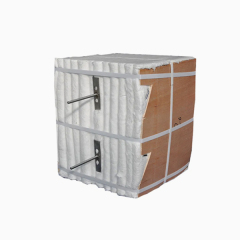
Modules come with pre-embedded stainless steel anchors for quick installation and replacement, compatible with various furnace designs. Subsequent maintenance requires only partial module replacement, significantly reducing downtime and maintenance costs.
Modules come with pre-embedded stainless steel anchors for quick installation and replacement, compatible with various furnace designs. Subsequent maintenance requires only partial module replacement, significantly reducing downtime and maintenance costs.
▶Excellent Erosion and Chemical Resistance
Suitable for complex furnace atmospheres containing mild acidic or alkaline gases, the dense fiber structure resists erosion under high-temperature, high-speed gas flow, prolonging the lining’s service life.
Suitable for complex furnace atmospheres containing mild acidic or alkaline gases, the dense fiber structure resists erosion under high-temperature, high-speed gas flow, prolonging the lining’s service life.
4. Applications
l Bio-soluble ceramic fiber modules are widely used in high-temperature equipment across multiple industries:
l Steel Industry: Heating furnaces, soaking pits, annealing furnaces, roller hearth furnaces, and other linings
l Petrochemical Industry: Cracking furnaces, reforming furnaces, heating furnaces, high-temperature flue ducts
l Ceramics Industry: Roller kilns, shuttle kilns, tunnel kilns, laboratory electric furnaces
l Non-ferrous Metallurgy: Aluminum electrolytic cells, casting furnaces, melting furnaces, and other furnace lining insulation
l Energy-saving Retrofits: Upgrading and replacing traditional linings, environmentally friendly heat treatment lines
l Electronics, Lithium Battery, and Precision Thermal Applications: Scenarios with strict occupational health requirements

5. Installation Instructions and Maintenance Recommendations
✅ Ensure the furnace shell is clean and dry before installation, and that anchor points are securely welded.
✅ Install modules sequentially according to the layout diagram, keeping compression directions consistent.
✅Control gaps between modules within a reasonable range to avoid thermal bridges.
✅ Minor gaps or uneven compression can be filled with ceramic fiber paper or loose fiber.
✅ Modules are non-load-bearing; avoid impact from heavy objects or stepping on them.
✅ Regularly inspect the anchor system and module surfaces, repairing or replacing damaged parts promptly.
6. FAQ
Q1: How do bio-soluble ceramic fiber modules differ from conventional ceramic fiber modules?
A1: The main difference lies in the raw materials. Bio-soluble modules use low biopersistence, eco-friendly fibers that are harmless to humans, making them ideal for markets with strict occupational health standards, such as Europe and the US.
A1: The main difference lies in the raw materials. Bio-soluble modules use low biopersistence, eco-friendly fibers that are harmless to humans, making them ideal for markets with strict occupational health standards, such as Europe and the US.
Q2: Can these modules be used long-term in environments above 1200℃?
A2: Type 1260 modules are recommended for long-term service at ≤1200℃. For higher temperatures, consider higher-grade modules (e.g., 1350 or 1430 types) to ensure structural stability and service life.
A2: Type 1260 modules are recommended for long-term service at ≤1200℃. For higher temperatures, consider higher-grade modules (e.g., 1350 or 1430 types) to ensure structural stability and service life.
Q3: What should I do if gaps or debris appear after installation?
A3: Small gaps can be filled with ceramic fiber paper or loose fiber. Debris is usually caused by insufficient compression or improper installation; increase compression or replace with high-density modules.
A3: Small gaps can be filled with ceramic fiber paper or loose fiber. Debris is usually caused by insufficient compression or improper installation; increase compression or replace with high-density modules.
Q4: Do bio-soluble fibers have a shorter service life than conventional ceramic fibers?
A4: When used within the recommended temperature range, the performance of bio-soluble fiber modules is comparable to conventional ceramic fibers, with an expected service life of 3–8 years.
A4: When used within the recommended temperature range, the performance of bio-soluble fiber modules is comparable to conventional ceramic fibers, with an expected service life of 3–8 years.
Q5: Does SUNTHERM support custom sizes and special anchor designs?
A5: Yes. We can provide customized modules based on your equipment drawings, operating temperature, and furnace shell material.
A5: Yes. We can provide customized modules based on your equipment drawings, operating temperature, and furnace shell material.
SUNTHERM bio-soluble ceramic fiber modules integrate environmental safety, high efficiency, and energy savings, making them the ideal insulation lining for industrial high-temperature thermal equipment. We are committed to providing high-quality products and professional thermal solutions to support green manufacturing and sustainable development.
For more technical information, samples, or custom services, please contact our engineering team for comprehensive support.
Review
Review
Send your message to us

