

A Visit to the Rock Wool Production Line: The "Transformation" from Rock to Insulation Rolls
Views : 156
Author : SUNTHERM
Update time : 2025-12-17 15:16:15
As a core material in the fields of building insulation and industrial noise reduction, rock wool is widely used in external wall insulation, pipeline insulation and other scenarios due to its multiple advantages such as fire resistance, flame retardancy, heat preservation and thermal insulation. How does this functional material, made from natural rocks, complete its transformation from hard rock to soft rolls?
Rock wool production line starts with raw material selection and proportioning. The core raw materials are mainly natural rocks such as basalt and diabase, which are accurately mixed with auxiliary materials like dolomite. Each batch of raw materials must undergo composition testing, be crushed into millimeter-level particles, and then sent to the core equipment - the cupola furnace - through the feeding system.
Rock wool production line starts with raw material selection and proportioning. The core raw materials are mainly natural rocks such as basalt and diabase, which are accurately mixed with auxiliary materials like dolomite. Each batch of raw materials must undergo composition testing, be crushed into millimeter-level particles, and then sent to the core equipment - the cupola furnace - through the feeding system.

High-temperature melting is a key link. The temperature inside the cupola furnace is maintained at a high level, where rock particles are melted into uniform magma. The melting state of the magma needs to be monitored in real time, as it directly affects the subsequent fiberization effect. The molten magma flows out through the bottom spout of the furnace and enters the fiberization and forming process. The industry mainly adopts the "centrifugal blowing method": the high-temperature magma flows into the high-speed rotating centrifugal roller, which is thrown into primary micro-meter-level fibers under the action of centrifugal force. Then, the fibers are further refined by high-pressure air blowing, and at the same time, phenolic resin binder is sprayed. The fibers accumulate on the collecting mesh belt to form continuous rock wool blankets.
The blankets then enter the curing furnace, where a stable three-dimensional structure is formed through the cross-linking reaction of the binder, improving compressive strength and dimensional stability. The cured rock wool blankets are cooled, cut into standard specifications, and then wound into rolls by a coiler. After passing the inspection, they are hermetically packaged and delivered from the factory.
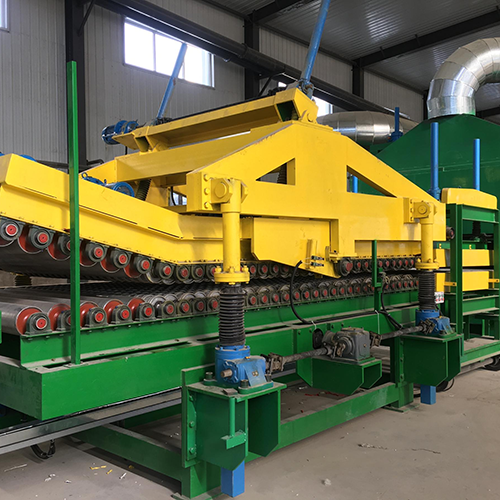
Throughout the production process, key parameters such as magma temperature and fiber fineness must be strictly controlled to ensure that the fire resistance limit of the finished product reaches Grade A. From natural rocks to functional rolls, rock wool production not only realizes efficient resource utilization, but also demonstrates the precision manufacturing capabilities of the material industry.
Related News


