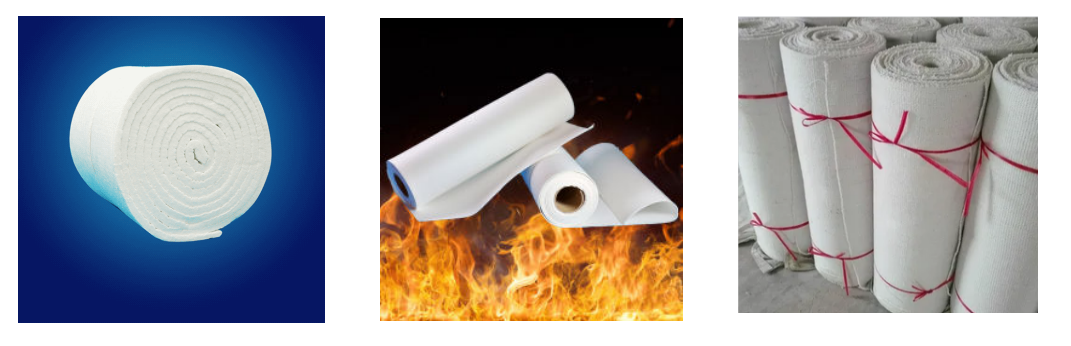
Properties of ceramic fibers
Ceramic fibers
Ceramic fibers are all non-metallic fibers (oxide and non-oxide) with the exception of fibers obtained from glass melts. The boundary between glass and oxide ceramic fibers is not so easy to draw, since ceramic fibers obtained by sol-gel technology can be amorphous, and in this sense similar to glass fibers; on the other hand, methods for producing ceramic fibers have recently been developed, including the production of an oxide charge melt. The term "glass" should refer to fibers obtained from melts of a silicate composition; the main group of oxide "ceramic" fibers are alumina-based fibers, although there are other fibers made from high-temperature oxides. A conditional gradation between glass and ceramic fibers can also be carried out according to the temperature of their application: the former can only be used up to 1150 ° C (silica fiber), the latter - at least up to 1400 ° C (in the case of SiC fibers in a non-oxidizing atmosphere) and 1600 ° C (for high-temperature oxide fibers based on Al 2 O 3 ), and in some cases up to 2000 and 2500 °C (fibers from ZrO2, ThO2).
Initially, in the early 1970s, oxide ceramic fibers were used as high-temperature heat-shielding materials, resistant up to 1600 °C, but not designed for any serious mechanical load. Ceramic fibers of small (no more than 10–20 μm) diameter have received a new round of development since the need arose to obtain reinforcing fibers for ceramic and metal composites with an application temperature above 500 °C.
For the successful application of ceramic fibers in the creation of such innovative materials, in addition to chemical and thermal stability at elevated temperatures, a number of other requirements are imposed on them. The first of these is sufficient flexibility - in order to make it possible to manufacture blanks of various shapes and sizes for further molding of the composite. Sufficient flexibility, even for materials with a high modulus of elasticity, provides a small diameter of the fibers - the flexibility is inversely proportional to the fourth power of the fiber diameter. For example, to obtain a fiber of aluminum oxide or silicon carbide with an elastic modulus of 300 GPa, a diameter of 10 μm is required. Also, for greater manufacturability of the process of obtaining composites, the value of the minimum value of the relative elongation of the fiber before failure is regulated: it should not be lower than 1%. This entails a fiber strength requirement: the minimum tensile strength of a fiber with an elastic modulus of 200 GPa must be 2 GPa. To facilitate the created materials and structures, requirements are also imposed on the density of the fiber - it should not exceed 5 g / cm 3 . Long-term chemical and thermal stability and creep resistance at temperatures above 1100 °C are essential.